
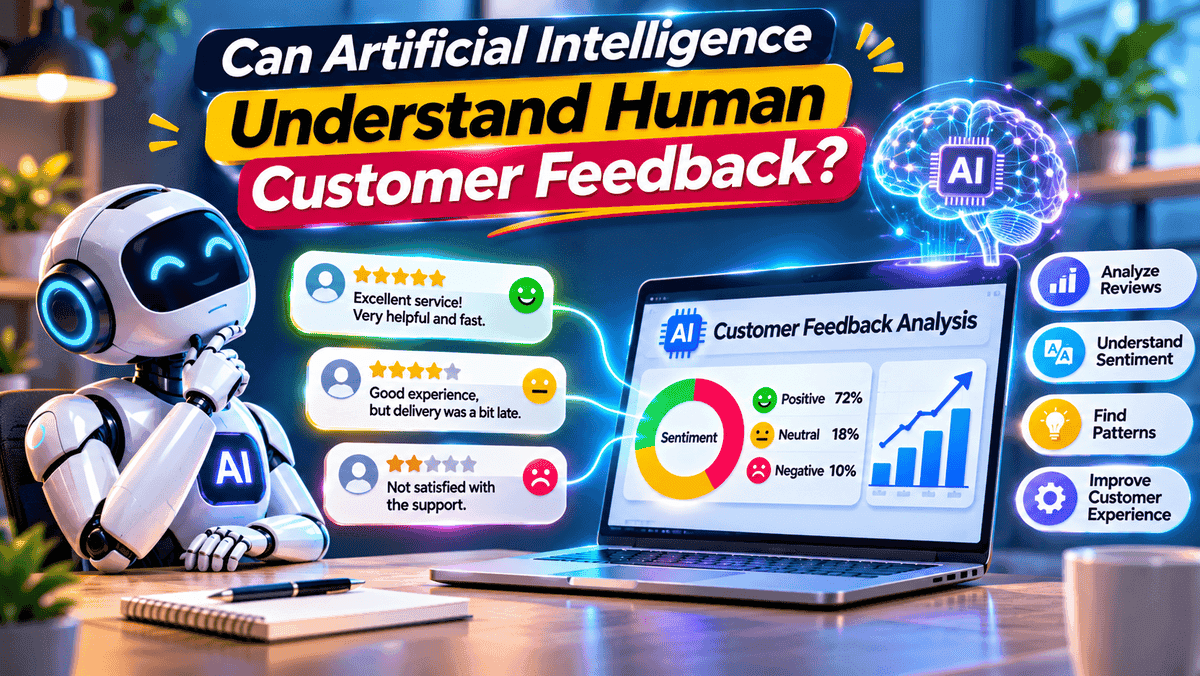
Can artificial intelligence understand human customer feedback? Yes, AI can read reviews, surveys, and support messages to find common complaints and customer opinions. It can group similar comments and spot positive or negative feedback. However, sarcasm, mixed feelings, and missing details can still confuse AI.
For businesses, the goal is simple. Use AI to find useful patterns, then check the findings before making changes.
How Does AI Understand Customer Feedback?
AI reads customer comments and looks for patterns in the language. It uses technology called natural language processing (NLP) to work with written and spoken words.
Imagine three customers leave these comments:
- "My order arrived three days late."
- "Delivery took longer than expected."
- "The product was great, but shipping was slow."
The wording is different, but all three mention a delivery problem. AI can place them in the same group.
It can also look for praise, complaints, and questions. This is called customer feedback analysis.
The difficult part is context. AI may recognize a complaint without knowing exactly what caused it.
What Can AI Learn From Customer Reviews?
Customer reviews often contain details that a star rating cannot show. AI can help businesses find those details without reading every comment one by one.
Find Common Customer Complaints
A restaurant might receive many reviews about slow service. Some customers mention long queues. Others say their food arrived late.
AI can group these comments under waiting times.
The owner can then check staffing and busy hours. The reviews point to a possible problem, but the owner still needs to find its cause.
Identify Positive and Negative Opinions
AI can often tell whether a comment sounds happy, unhappy, or neutral.
"The staff were friendly" sounds positive. "Nobody answered my call" sounds negative.
Some reviews contain both. A customer might love the food but dislike the service. A useful AI tool should recognize these different opinions instead of giving the whole review one simple label.
Notice Changes Over Time
A business may receive few delivery complaints in January but many in February.
AI can help spot that change. The owner can then check whether delivery times, prices, or shipping partners changed.
This is more useful than looking at one review in isolation.
Summarize Large Groups of Comments
Reading hundreds of reviews takes time. AI can prepare a short summary of the main topics.
For example, a report might show that customers often praise product quality but complain about slow replies.
Managers can use that summary to decide which comments need a closer look.
What Customer Feedback Can AI Analyze?
AI can work with different types of feedback. Each source tells a slightly different story.
- Google Reviews: AI can find praise and common complaints. Businesses can use these findings to improve local service.
- Customer surveys: AI can identify suggestions and satisfaction levels. This can help managers plan improvements.
- Support tickets: AI can spot repeated problems and common requests. Support teams can use these findings to fix recurring issues.
- Social media comments: AI can identify questions and public opinions. Businesses can use them to understand customer concerns.
- Chat messages: AI can find unanswered questions and common needs. These findings can help improve replies.
- Call transcripts: AI can identify common requests and complaints. Managers can use the results to review call handling.
A public review may describe a memorable visit. A support ticket may explain a problem that still needs fixing.
Looking at both can help, but not every customer leaves feedback. AI cannot speak for customers who never shared their views.
How to Analyze Customer Feedback With AI
A small business can start with a simple process. There is no need to build a complex system.
Step 1: Gather the Feedback
Collect reviews, survey answers, or support messages from a set period.
Keep the date and source of each comment. Remove duplicate entries and private details before sharing the data with an AI tool.
Step 2: Ask a Clear Question
Decide what the business needs to learn.
For example, a café might ask, "What do customers complain about most during weekends?"
That question gives the analysis a clear purpose.
Step 3: Group Similar Comments
Ask the tool to sort feedback into topics.
These might include delivery, price, staff, product quality, and waiting times.
One review can belong to more than one group. A customer may praise the product and complain about shipping in the same message.
Step 4: Check the Results
Read some of the original comments in each group.
Look closely at mixed opinions, jokes, and angry messages. Check whether the AI has understood them correctly.
Do not rely only on a sentiment score.
Step 5: Make a Change and Review It
Choose one problem the business can address.
For example, a shop might update confusing delivery information. It can then check later feedback to see whether customers still mention the same issue.
The aim is to solve problems, not just produce reports.
A Realistic Example of AI Customer Feedback Analysis
Imagine a neighborhood café receives 120 reviews over two months.
The owner uses AI to group the comments. The tool produces this fictional report:
- Friendly staff: Mentioned in 46 reviews. The owner can keep the current service standards.
- Slow weekend service: Mentioned in 28 reviews. The owner can check staffing during busy hours.
- Coffee quality: Mentioned in 39 reviews. The café can continue regular quality checks.
- Limited seating: Mentioned in 17 reviews. The owner can review seating options.
These numbers are only an example. They are not results from a real business.
One review may mention several topics, so the figures do not represent separate customers.
The owner notices that waiting times appear in 28 reviews. Before hiring more staff, the owner reads those comments and checks when the delays happened.
This is where AI becomes useful. It points to an issue worth checking. The business decides what to do next.
Can AI Understand Customer Emotions and Sarcasm?
AI can recognize many emotional words. Still, it sometimes misses what a customer really means.
Consider this review:
"Wonderful. Another 40-minute wait for a five-minute appointment."
The word "wonderful" sounds positive. But the customer is clearly unhappy.
Now consider another comment:
"The food was excellent, but the staff seemed rushed."
This review contains praise and criticism. One overall score may hide that difference.
Local expressions, jokes, spelling errors, and missing details can also cause mistakes.
That is why businesses should check important comments themselves. AI can suggest what a customer feels, but it cannot always know for sure.
AI vs Human Customer Feedback Analysis
AI is useful for sorting large amounts of feedback. People are often better at understanding unusual situations.
Here is how they compare:
- Reading hundreds of comments: AI can process large groups quickly. Human reviewers usually need more time.
- Grouping complaints: AI can sort similar comments. People can check whether the groups make sense.
- Understanding sarcasm: AI may miss the intended meaning. A person can often understand it from the context.
- Identifying mixed opinions: Some AI tools can separate praise from criticism. People can examine both sides of a review.
- Suggesting improvements: AI can highlight possible problems. Managers decide which changes are practical.
- Handling sensitive complaints: AI can prepare a draft reply. A person should review it before sending.
The best approach is often to use both.
AI can find the comments that need attention. A person can read them, understand the situation, and choose a fair response.
How Can Businesses Use AI Feedback Insights?
A report is only useful when it helps a business do something better.
Improve Products and Services
A clothing shop may notice repeated complaints about confusing sizes. A repair company may see comments about late appointments.
These patterns give managers a place to start.
They can check the issue, make a change, and watch future feedback.
Write Better Replies to Reviews
AI can help sort reviews and draft replies.
But every reply should match the customer's experience. A complaint about a late order needs a different answer from a complaint about rude service.
Thoughtful replies also matter for public trust. Read more about how customer reviews build trust for local brands.
Compare Customer Feedback Over Time
Businesses can check whether complaints increase or decrease after a change.
A company with several locations can also compare common topics at each branch.
The findings may show where to investigate. They do not always explain why a problem happened.
Businesses can also use customer feedback to improve their online profiles. Repeated questions about opening hours, services, or contact details may show what needs attention. Google Business Profile optimization can help businesses keep this information clear and useful for customers.
What Are the Limits of AI Feedback Analysis?
AI can make mistakes. Businesses should understand these limits before trusting a report.
- Sarcasm: AI may take a joke or sarcastic remark literally.
- Mixed opinions: A review may contain both praise and criticism.
- Missing context: A short comment may not explain the full problem.
- Incomplete data: Reviews do not represent every customer.
- Wrong summaries: AI may miss details or group unrelated issues.
- Privacy: Customer names and personal details need protection.
Businesses should also check how an AI tool stores and uses uploaded information.
A good rule is to remove private details where possible and check major findings against the original feedback.
How to Choose an AI Customer Feedback Tool
Start by thinking about the business's needs.
A small shop with 30 reviews may need a simple tool. A company handling thousands of support messages may need more features.
Before choosing, check these points:
- Can it read the feedback sources the business uses?
- Can it group comments by topic?
- Can it identify both positive and negative points in one review?
- Can users open the original comments behind a summary?
- Does it support the languages customers use?
- How does it protect customer information?
Test the tool with a small group of comments first. Check its answers by hand.
A clear, accurate report is more useful than a fancy dashboard with unreliable results.
Frequently asked questions
Final Thoughts
Artificial intelligence can help businesses make sense of customer feedback. It can sort reviews, find repeated complaints, and show changes in customer opinions.
But a report cannot tell the whole story. Businesses still need to read important comments and understand what happened.
AI works best as a helping tool. People should remain responsible for the decisions that affect customers.
Growth Specialist
Specializes in helping local businesses maximize online visibility and customer engagement.
About the Author
Sarah JohnsonGrowth Specialist
Specializes in helping local businesses maximize online visibility and customer engagement.