

In today’s digital landscape, your business reputation is shaped by online reviews, social media comments, search engine results, and every digital footprint your brand leaves behind. Only 5% of users look beyond the first page of Google search results, meaning your online presence needs to be impeccable from the first impression.
For USA businesses competing in an increasingly digital marketplace, managing your online reputation isn’t optional—it’s essential for survival and growth.
What Is Online Reputation Management?
Online Reputation Management (ORM) is the strategic process of monitoring, influencing, and improving how your business is perceived across digital channels. Unlike traditional marketing that focuses on what you say about yourself, ORM controls what others say about you online.

It combines multiple disciplines to ensure your brand maintains a positive digital footprint:
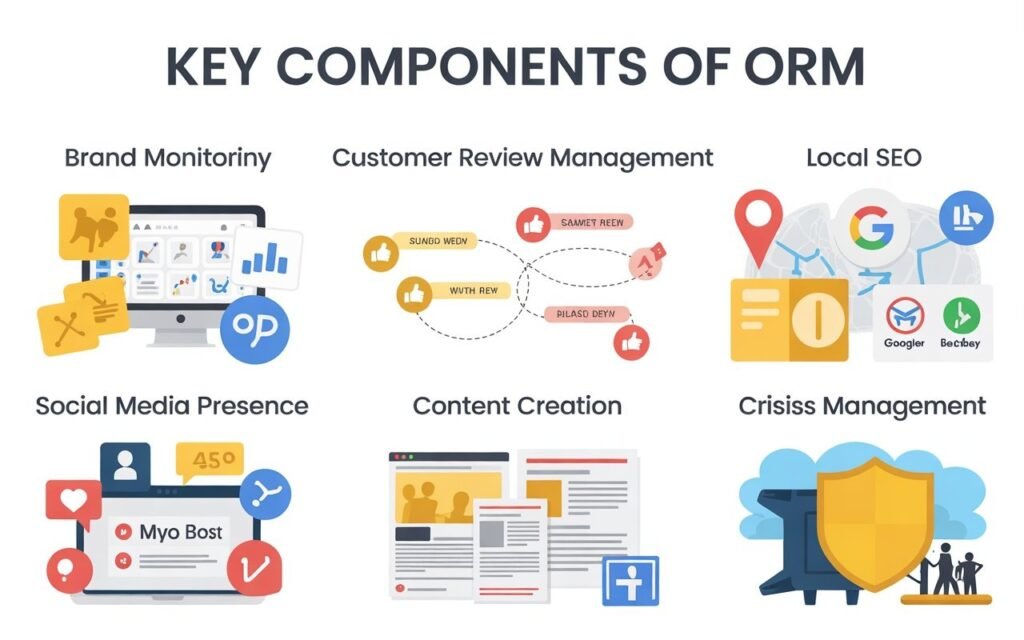
- Reputation monitoring: Tracking mentions across review sites, social media, forums, and news outlets
- Review management: Responding to customer feedback on Google, Trustpilot, Facebook, and industry platforms
- Content creation and SEO: Developing positive content that ranks well and represents your brand accurately
- Social media engagement: Building relationships and addressing concerns on platforms where your audience spends time
- Crisis management: Responding quickly when reputation threats emerge
ORM vs SEO: Understanding the Difference
While SEO focuses on improving visibility and driving traffic through keywords, ORM concentrates on shaping perception and managing sentiment. These disciplines overlap—positive reputation efforts often improve search rankings, and strong SEO helps promote favorable content about your brand.
Online Reputation Management in Digital Marketing
ORM is a critical component of digital marketing strategy that works alongside traditional marketing channels. While paid advertising and social media campaigns control what you say about your brand, ORM manages what others say about you—customer reviews, social mentions, and third-party content.
In a comprehensive digital marketing approach, ORM ensures that all your marketing investments aren’t undermined by negative search results or poor review ratings. When integrated properly, ORM amplifies your marketing effectiveness by building the trust and credibility that converts prospects into customers.
Why Online Reputation Management Matters for Your Business?
Your online reputation directly impacts your bottom line. Research shows that 90% of consumers read online reviews before purchasing, and 84% trust these reviews as much as personal recommendations.
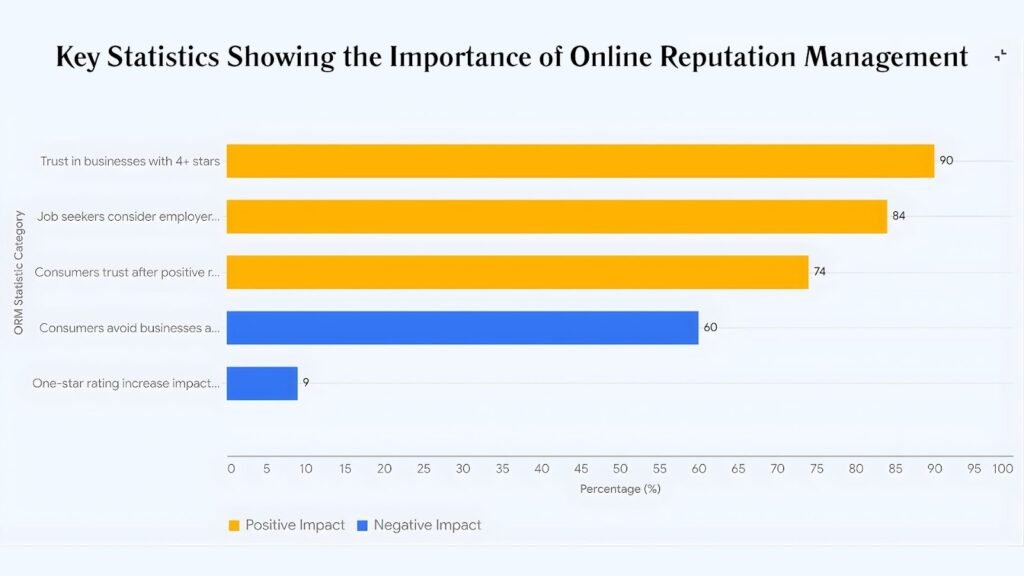
Key statistics that prove the importance of ORM:
- Customers don’t trust companies with ratings below 4 stars
- 74% of consumers trust a business more after reading positive reviews
- 60% of consumers avoid businesses after reading negative reviews
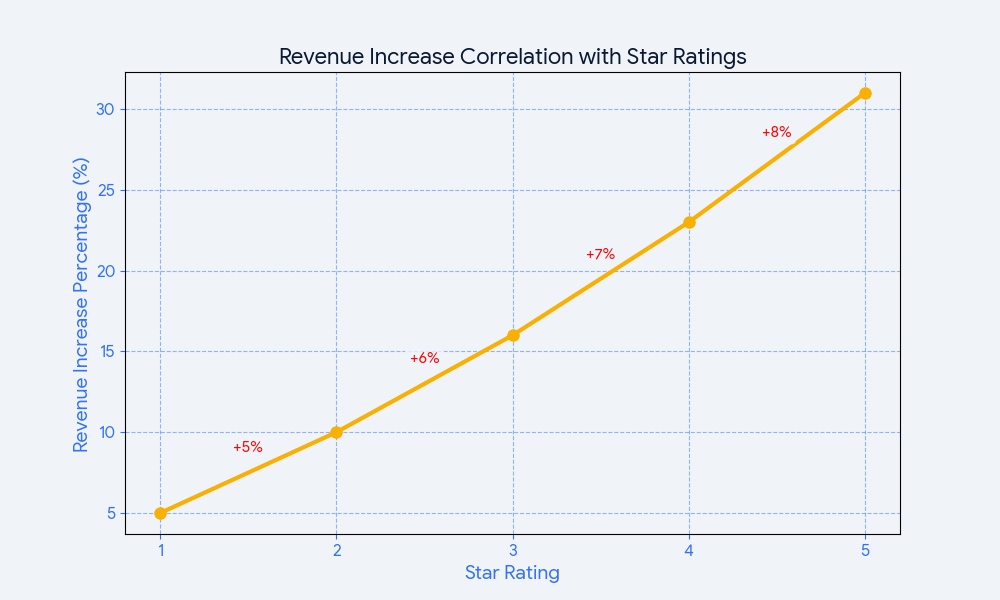
- A one-star rating increase can boost business by 5-9%
- 84% of job seekers consider employer reputation important when applying
Building Trust and Credibility
Trust is the foundation of customer relationships. When potential customers find consistent positive reviews, professional responses to feedback, and an active online presence, they gain confidence in choosing you over competitors. This is particularly crucial for B2B companies where decisions involve larger investments and longer commitments.
Competitive Advantage in Crowded Markets
In competitive industries, your online reputation sets you apart when products and pricing are similar. Customers naturally gravitate toward businesses with higher ratings, more positive reviews, and better online engagement.
Customer Retention and Loyalty
When customers see you actively respond to feedback and continuously improve, they’re more likely to remain loyal. This reduces churn rates and increases customer lifetime value—both critical for sustainable growth.
Crisis Prevention and Damage Control
Proactive reputation management allows you to detect and address potential crises before they escalate. Real-time monitoring enables quick responses that can transform negative situations into opportunities to showcase excellent customer service.
Key Components of Online Reputation Management
Understanding these core components helps you build a comprehensive strategy that protects and enhances your reputation across all channels.
Brand Monitoring and Social Listening
Continuous monitoring is the foundation of ORM. You cannot manage what you don’t measure. Modern tools track mentions across social media, review sites, blogs, forums, and news outlets, providing real-time insights into what people say and the sentiment behind their words.
Critical questions to ask when auditing your reputation:
- Is your brand well-known online with strong social media following?
- How do customers perceive your products and services?
- What content appears in search results—positive, neutral, or negative?
- How does your reputation compare to competitors and industry benchmarks?
Customer Review Management
Online reviews are the cornerstone of digital reputation. They provide social proof, influence search rankings, and directly impact customer decisions. Effective review management involves encouraging reviews from satisfied customers, responding promptly to all feedback, and analyzing review data for improvement opportunities.
Research shows 53% of customers expect responses to negative reviews within a week, with one in three expecting responses within three days. Meeting these expectations demonstrates you value customer feedback and are committed to improvement.
This is where having a strong foundation of positive reviews becomes invaluable. Services like Buy Organic Reviews help businesses establish credibility with authentic Google reviews, providing the social proof needed to build trust with potential customers.
Local SEO and Business Listings Management
97% of people discover local businesses online, making accurate business listings essential. Your listings on Google Business Profile, Bing Places, and industry directories serve as your digital storefront. Inconsistent information—wrong hours, old phone numbers, missing URLs—frustrates potential customers and damages reputation before they contact you.
Social Media Presence and Engagement
Social media offers unique opportunities for reputation building through authentic engagement. The most respected brands maintain active presences that provide genuine value beyond promotional content. Monitor conversations, respond to questions, address concerns, and participate in relevant discussions to humanize your brand.
Content Creation and Brand Storytelling
Your reputation is shaped by what you say about yourself. Strategic content creation ensures people find accurate, positive information when searching your business. Maintain an updated website, publish blog posts showcasing expertise, create case studies, and share authentic testimonials. Quality content supports SEO efforts and pushes down negative content in search results.
Crisis Management Planning
No business is immune to crises, but preparation makes the difference. A crisis management plan outlines procedures for responding to reputation threats—from viral negative reviews to service failures. Having frameworks in place before crises occur enables swift, coordinated responses that mitigate damage and strengthen trust.
How to Build an Effective Online Reputation Management Strategy?
Creating a robust ORM strategy requires systematic planning and consistent execution. Here’s a step-by-step approach to building a reputation management framework that protects your brand and drives business growth.
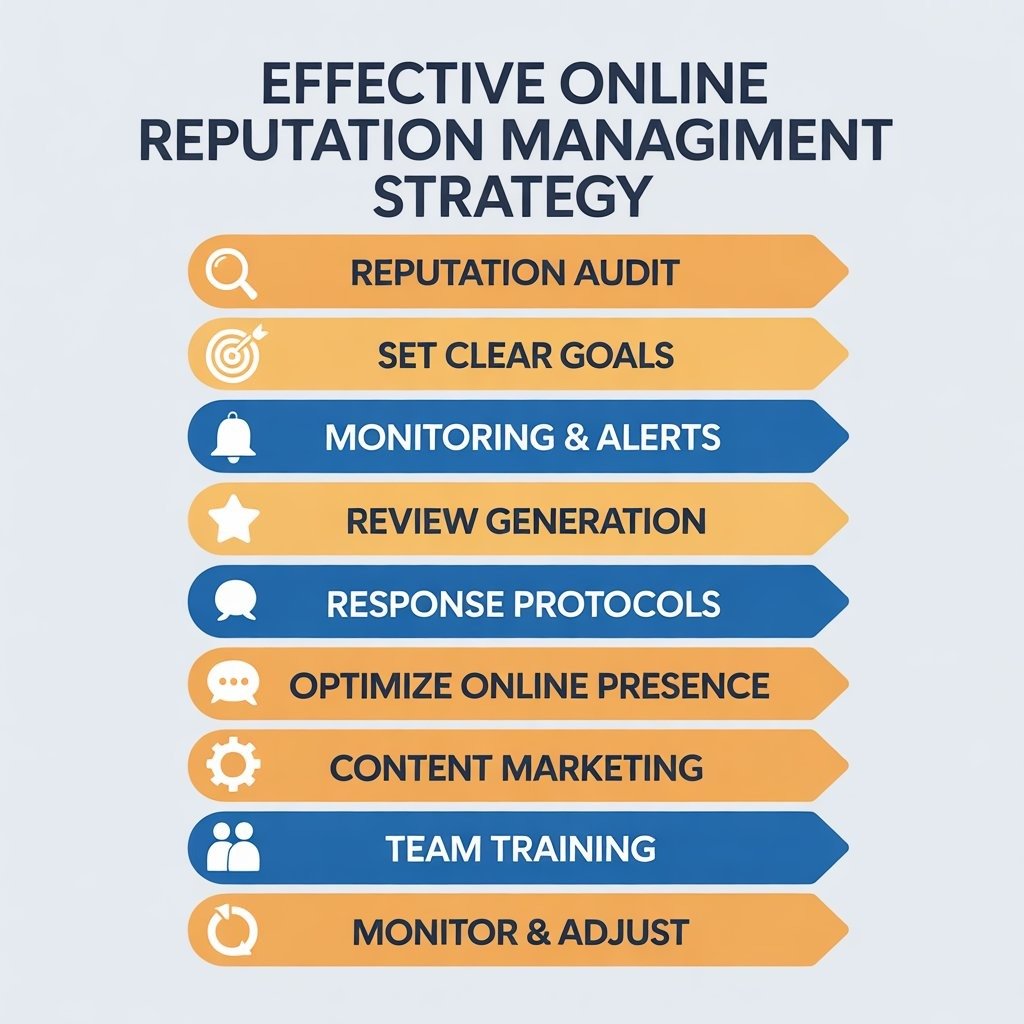
Step 1: Conduct a Comprehensive Reputation Audit
Search your business name on Google and examine first-page results. Check your presence on major review platforms and note ratings and recent reviews. Use social listening tools to discover where your brand is discussed. Compare your presence to competitors to identify gaps and opportunities.
Step 2: Set Clear, Measurable Goals
Use SMART goals (Specific, Measurable, Achievable, Relevant, Time-bound) to define success. Examples include increasing average rating from 4.2 to 4.6 stars within six months, reducing review response time to 24 hours, or generating 50 new positive reviews quarterly.
Step 3: Establish Monitoring and Alert Systems
Implement tools providing real-time notifications when your brand is mentioned. Set up Google Alerts for your business name and monitor review platforms daily. The faster you detect reputation issues, the better you can control the narrative.
Step 4: Create Review Generation Workflows
Develop systematic processes for requesting feedback from satisfied customers at optimal moments. Provide direct links to preferred review platforms and make the process frictionless. Buy Organic Reviews can help jumpstart this process with genuine Google reviews that establish credibility.
Step 5: Develop Response Protocols
Create clear guidelines for responding to different feedback types. Outline response timeframes, approval processes, tone guidelines, and escalation procedures. Train team members to ensure consistent, professional responses across all platforms.
Step 6: Optimize Your Online Presence
Ensure all digital properties accurately represent your brand and are optimized for search engines. Update outdated information, add high-quality images, complete profile sections, and maintain consistency in branding across platforms.
Step 7: Implement Content Marketing
Develop a content calendar publishing valuable, relevant content showcasing expertise and customer success. Focus on topics your audience cares about, answer common questions, and demonstrate thought leadership. Consistent quality content builds authority and trust over time.
Step 8: Train and Empower Your Team
Online reputation management requires organization-wide commitment. Frontline employees, customer service representatives, and managers all impact customer experiences that become online reviews. Provide training and empower employees to resolve issues before they become negative reviews.
Step 9: Monitor, Analyze, and Adjust
Regularly review metrics against established goals and analyze trends in feedback and sentiment. Use customer feedback as a guide for business improvements. Adjust your strategy based on what’s working—if certain review request methods generate better responses, focus on those approaches.
The Connection Between Reviews and Online Reputation
Customer reviews sit at the heart of online reputation management. They serve as the most trusted form of social proof, directly influencing consumer behavior and search engine rankings.
Why Reviews Matter More Than Ever
Modern consumers are research-driven. Before purchasing, people extensively investigate options online, and reviews are their primary trusted source. This authenticity makes reviews extraordinarily influential—positive reviews make 74% of consumers trust a business more, while 60% avoid businesses after reading negative reviews.
The Business Impact of Reviews
Each one-star rating increase can boost revenue by 5-9%. Strong reviews reduce customer acquisition costs—positive word-of-mouth does marketing work that would otherwise require paid advertising. Reviews also provide competitive differentiation when products or services are similar.
Building a Strong Review Foundation
Establishing credibility through reviews takes time, especially for new businesses. Many successful businesses accelerate this process by strategically building their initial review base through services like buyorganicreviews.com, which provides authentic Google reviews that help establish necessary social proof. (Internal link opportunity: Link to main service page)
Encouraging Organic Reviews
Once you’ve established a baseline, focus on generating ongoing organic reviews. Request reviews when customer satisfaction is highest—immediately after successful delivery or exceptional service. Provide direct links to review forms and follow up with gentle reminders.
Responding to Reviews Effectively
Every review deserves a response. For positive reviews, express genuine gratitude and personalize responses by mentioning specific details. For negative reviews, respond promptly (ideally within 24 hours), acknowledge frustration, apologize sincerely when appropriate, and offer concrete solutions.
A professional, empathetic response to criticism can actually enhance reputation, showing you take concerns seriously and work actively to make things right. Avoid defensiveness even when reviews seem unfair.
Leveraging Reviews for Business Improvement
Beyond marketing value, reviews provide actionable intelligence. Analyze content for recurring themes—what do customers consistently praise? What complaints appear repeatedly? Use positive insights to identify competitive strengths and negative patterns to prioritize operational improvements.
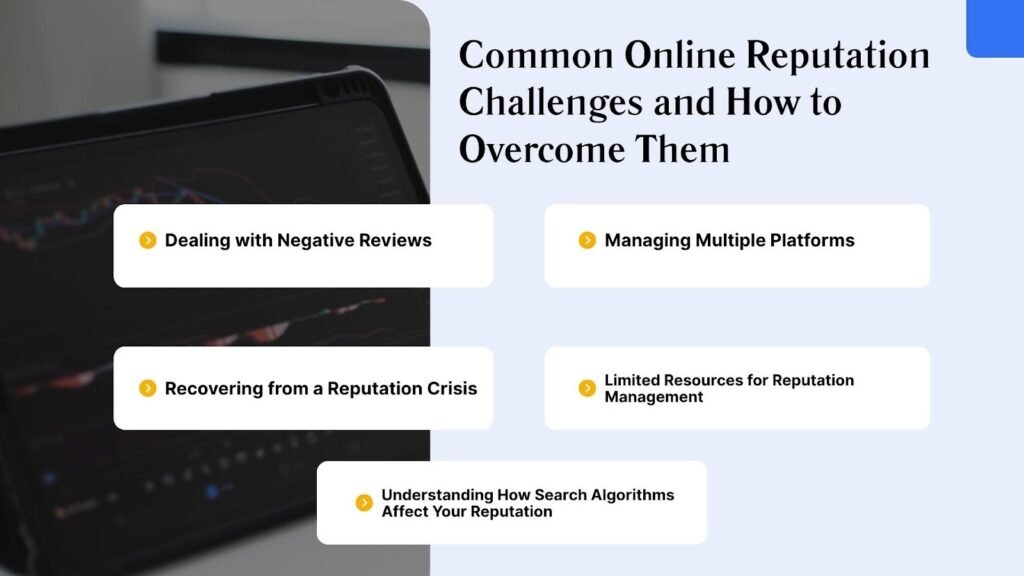
Common Online Reputation Challenges and How to Overcome Them
Even with proactive reputation management, challenges inevitably arise. Understanding common scenarios and having response strategies prepared helps you navigate difficulties while protecting your brand.
Dealing with Negative Reviews
Negative reviews are inevitable—what matters is your response. For legitimate negative feedback, respond promptly, apologize for shortfalls, and offer to make it right. Contact customers privately to resolve issues and, if successful, politely ask if they’d consider updating their review.
For fake or malicious reviews, report them through proper platform channels. Remember that negative reviews, when handled well, can actually enhance reputation by demonstrating transparency and commitment to customer satisfaction.
Managing Multiple Platforms
Prioritize platforms based on where customers are most active. For most USA businesses, Google Business Profile should be the top priority. Identify 2-3 additional crucial platforms and focus efforts there rather than spreading too thin. Use reputation management tools that consolidate mentions into centralized dashboards.
Recovering from a Reputation Crisis
When crisis strikes, respond quickly but thoughtfully. Acknowledge the issue publicly, take responsibility, explain what happened, outline specific resolution steps, and provide timelines. Avoid deleting negative comments—face issues head-on with honesty and visible commitment to making things right.
Limited Resources for Reputation Management
Start with fundamentals: set up monitoring alerts, establish weekly routines for checking platforms and responding to reviews, and train existing staff to be reputation-conscious. Automate what you can and focus energy on high-impact activities. Consider strategic outsourcing for specific aspects like establishing review foundations through Buy Organic Reviews.
Understanding How Search Algorithms Affect Your Reputation
Search engines prioritize popularity over accuracy, relying on engagement metrics like clicks and shares rather than content truthfulness. This means sensational or negative content often ranks higher than positive, accurate information simply because it’s more “clickable.” Understanding this algorithmic bias helps you develop ORM strategies that counteract these trends with authoritative, engaging positive content.
Conclusion:
In today’s digital world, your online reputation is crucial to your business’s success. Every review, social media mention, and search result shapes how potential customers perceive you. Effective reputation management involves consistently monitoring your presence, responding promptly, encouraging feedback, and improving customer experiences.
For USA businesses, building a foundation of trusted reviews is essential. Buy Organic Reviews helps businesses gain authentic Google reviews to enhance credibility and attract organic feedback. Your reputation is your most valuable asset—protect it, nurture it, and watch it become your strongest marketing tool.
FAQs
Q. How long does it take to see results from online reputation management efforts?
Most businesses notice improvements within 3–6 months, depending on consistency and strategy. Search engines take time to reflect new content and review activity.
Q. Can negative reviews be removed from Google or other platforms?
Only reviews that violate content policies can be removed. For all others, respond professionally and encourage positive feedback to balance them out.
Q. What’s the difference between ORM and traditional SEO?
SEO boosts visibility for keywords, while ORM shapes brand perception across platforms. ORM focuses on reviews, mentions, and content that reflect brand trust.
Q. Is ORM worth it for small local businesses?
Yes—most consumers check reviews before choosing a local service. Strong reputation boosts trust, conversions, and long-term customer loyalty.
